
From puff detection to battery power: B09-16P and B43-6P inside a heat-not-burn e-cigarette
Every puff is a relay between sensor and battery. In heat-not-burn devices, B09-16P carries MEMS differential-pressure sensor signals to the MCU, while B43-6P delivers 12A battery power to the heating section. Two 0.35mm/0.30mm-pitch platforms, each doing its own job inside a slim rod.
The moment a user draws on the mouthpiece, a relay shorter than one second begins: a sensor captures the pressure change in the airflow channel, the MCU confirms the puff and compensates power instantly, and the battery delivers high-current pulses to hold the heating element in its 330–350°C constant-temperature zone. Behind this are two easily overlooked connections — between the sensor FPC and the main board, and between the battery and the main board. They map exactly to CPTGR's two board-to-board platforms: B09 and B43.
Puff detection: from ECM capsules to MEMS differential-pressure sensors
Early e-cigarettes detected puffs with electret capacitor capsules: airflow deforms a conductive diaphragm, and triggering occurs once the capacitance change crosses a threshold. The scheme is simple but suffers from poor consistency, sensitivity to dust and humidity, and manual soldering — hard to scale with stable yield.
The industry mainstream is shifting to MEMS airflow/pressure sensors: silicon devices are stable, reflow-solderable with SMT processes, and their I2C digital output gives the MCU high-resolution data tied to puff strength and duration.
- Puff-strength recognition: real-time pressure data drives dynamic power compensation for a consistent taste profile.
- Puff counting and duration control: the data foundation for usage management and compliance features.
- Low-pressure protection: recognises sudden ambient changes such as fast elevators or air travel to prevent false triggers.
- Self-diagnostics: baseline monitoring detects a blocked airflow channel or sensor fault and raises an alarm.
The differential-pressure architecture is now the mainstream evolution: one side senses ambient pressure, the other senses the airflow channel, and the puff is judged from the difference. Compared with a single absolute-pressure sensor, it significantly reduces false triggers from weather, altitude and fast elevation changes — the detection architecture commonly adopted by heat-not-burn (HNB) devices.
B09-16P: delivering complete sensor signals to the MCU
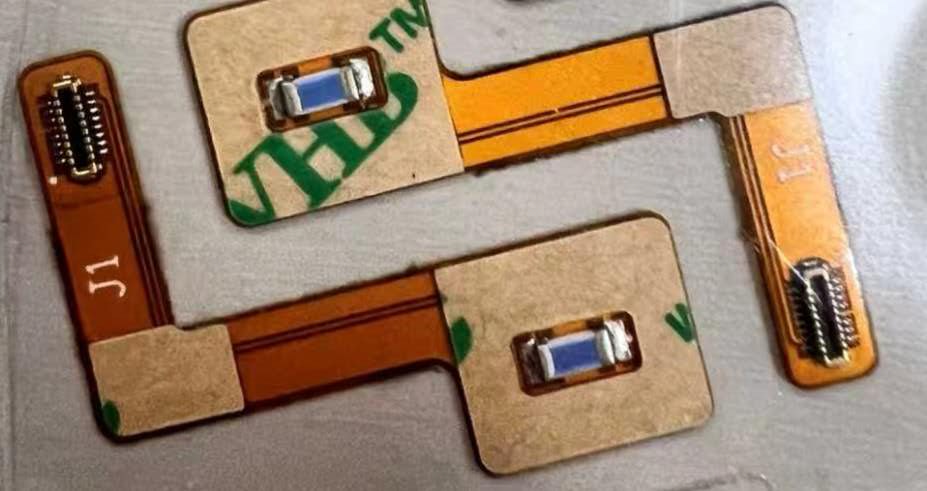
The photo shows a typical HNB detection assembly: a MEMS differential-pressure sensor on a slim FPC, fixed to the inner wall of the rod with 3M adhesive, and mated to the main board through a board-to-board connector — position J1 in the image is the B09-16P.
The B09 platform (BB0009) is a 0.35mm-pitch board-to-board family covering 6–60PIN with a 0.6mm mounting height, supplied as mating socket/header pairs. Designed with an N+2 structure (N signal PINs + 2 power PINs), the 16P variant routes differential-pressure sampling, temperature compensation, the I2C bus and supply power in one pass; the sensor runs on a regulated 3.0V rail with I2C straight to the MCU, no extra conversion needed.
B09 is fully compatible with the BK13C06 series and supports AB configuration — male/female halves cross-mate with original-brand parts on identical pads and heights, so in-production e-cigarette projects can substitute without a board respin.
Battery connection: B43-6P and its 12A path
The battery section of an HNB device is far more stressed than a typical vaporizer: preheating must raise the ceramic heater to set temperature (usually 330–350°C, with a roughly 30°C overshoot on the first puff) within 6–10 seconds, and each puff triggers instantaneous power compensation — the battery discharges in high-current pulses.
The B43 platform (BB0043) is engineered for exactly this: a 12A high-current and signal composite board-to-board at 0.30mm pitch and 0.6mm height, where 4PIN/6PIN variants are dedicated battery connectors. Within the 6PIN layout, multiple terminals operate in parallel to share current, cutting per-point contact resistance and heat, delivering battery power to the heating section with minimal loss; the current-plus-signal composite form also fits large-board/small-board stacking architectures.
At low temperature, battery internal resistance rises and discharge capability drops — low-resistance, stable contact in the connector chain matters even more, because tiny contact-resistance differences are amplified into perceptible heat and voltage drop in a 12A loop.
Structural homework inside a slim rod
E-cigarettes concentrate nearly every consumer-electronics connector challenge into one elongated body:
- Sealing and leak resistance: the cartridge and control sections must be isolated; condensate and e-liquid seepage are the number-one cause of terminal corrosion, so terminal retention and plating corrosion resistance directly define device lifetime.
- Thermal cycling: the heating section works at 330–350°C and conducts heat along structural parts toward the control section; connectors must stay stable across wide temperature swings and repeated cycles.
- Micro-vibration and drops: daily carry vibration, pocket squeeze and drops demand reliable terminal retention so contact resistance never drifts.
- Low profile: within a limited rod diameter, the 0.6mm mounting height of B09 and B43 leaves stacking margin.
On manufacturing, CPTGR runs a full Insertmold process with plating-after-molding: terminals are precision over-molded first, then selectively plated, guaranteeing terminal position accuracy, flux resistance and leak resistance in one integrated step while saving plating tooling and assembly automation investment — precisely the supply-chain form that high-volume, high-consistency e-cigarette programs need.
Quick selection guide
- B09-16P: 0.35mm pitch · 16PIN · 0.6mm mounting height · N+2 structure · compatible with BK13C06, AB configuration supported · sensor FPC to main board.
- B43-6P: 0.30mm pitch · 6PIN · 12A · 0.6mm mounting height · dedicated battery connection · power loop between boards.
- Other PIN counts (B09 6–60PIN, B43 4PIN/68PIN composite platform) extend on the same platforms without changing the stacking approach.
The experience floor of a heat-not-burn device is set jointly by accurate puff detection and a low-resistance power loop. Design B09 and B43 into the stack so sensor signals and battery power each travel their own reliable channel. For samples, datasheets or a compatibility review against your current solution, contact us.
Related product documents
B43 series (BB0043) · 12A high current + signal
Precision BTB · pitch 0.30mm
Send us your stack-up requirement
Share board thickness, available height, channel count and operating environment and we will recommend and quote within 24 hours.